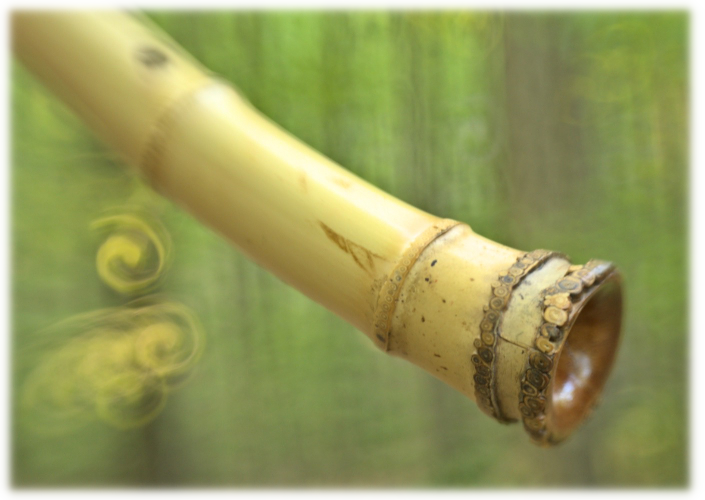
Pioneering Japanese madake bamboo grown in The US


shakuhachi madake grove Jon Harry shakuhachi madake grove
Left - Jon Kypros playing shakuhachi under 80 foot tall madake culms, Alabama 2010. Right - Jon and his father Harry at the same grove.

I am pioneering the use of Japanese madake bamboo growing in The US for the making of shakuhachi. I am also one of the few shakuhachi makers left in the world who personally harvests all of his own Japanese madake bamboo. This is significant because I select my bamboo based on my experiences as a craftsman of jinashi shakuhachi vs. relying on professional harvesters who are often not shakuhachi makers or players and who harvest bamboo based on ideals set for jiari type shakuhachi, not jinashi shakuhachi. I am proud to be pioneering this domestic or "local" solution which is more beneficial economically and environmentally.

shakuhachi harvest jm
Jon (right) and Mr. Mortensen (far left) and Jon's father Harry at JM bamboo (jmbamboo.com), Alabama

In 2010 I met with Jim Mortensen who has identified possibly the largest concentration of old established Japanese madake groves in America. Jim does not grow much madake at his nursery probably because there is so much in the area. The "Alabama groves" are where I harvest most all of my Japanese madake.

haiku bamboo keiji oshima shakuhachi
Jon (right) and Keiji Oshima of haiku bamboo (haikubamboonursery.net), Hendersonville, NC

In 2011 I moved to the mountains of Asheville, Western North Carolina. Just one town over from me in Hendersonville lives Keiji Oshima who has been growing Japanese madake and other Japanese bamboo in the mountains for over 30 years.

History of Japanese madake bamboo in America


history madake America

The famous Botanist David Fairchild (1869-1954) said that, "P. Bambusoides [madake] was introduced [to The US] by a one Andreas E. Moynello probably in the late 1880's". With a reputation as a world traveller as well as rice planter, Moynello is said to have introduced Phyllostachys bambusoides to Vallambrosa plantation (now the Coastal Georgia Botanical Gardens) after a visit to Japan. It has since been planted more than any other running bamboo in The US.

About this amazing plant - Japanese madake bamboo


jon shakuhachi bamboo root
Jon Kypros playing shakuhachi at the foot of madake rhizome roots, Alabama 2010

Stepping into a mature madake bamboo grove is like entering another universe. You feel dwarfed by towering bamboo giants. A bamboo grove is a testament to the resilience of life on earth. It becomes apparent upon seeing the bamboo grove that the shakuhachi truly embodies the simplicity and versatility of bamboo. The shakuhachi is held upright with root facing down which shows us how bamboo grows out in nature. We, also being a part of nature, utilize the bamboo's natural dimensions which serendipitously provide us with shakuhachi.

It is quite an experience to dig up bamboo in the cold winter months and, much later, play the first note on a shakuhachi. Phyllostachys bambusoides, also known as "madake" or "giant Japanese timber bamboo" is not the best bamboo for shakuhachi because it is synonymous with Japan but rather because of its physical characteristics.

While madake bamboo can grow in a wide variety of climates it grows best for shakuhachi in areas such as The South Eastern US. These places share similar climates with parts of Japan. The "micro-climate", such as the soil, the lay of the land, and how much sun the bamboo receives, all determine how the bamboo will grow and if it will be suitable for shakuhachi. Bamboo is like a chameleon which is why only the new shoots can provide a 100% positive ID when expertly examined in the spring.

Harvesting Japanese madake bamboo for shakuhachi


harvest shakuhachi
Jon harvesting a P. bambusoides "Castillon" at Jim's request to make him a shakuhachi from bamboo he grew himself

Many gruelling hours are spent digging up the root end of the bamboo for making shakuhachi. Besides the roots of the stalk itself each root ball is connected to the "mother of bamboo" or the rhizome. The rhizome is the subterranean womb of the bamboo grove which gives birth to each stalk. The new shoots bud from the rhizome and soon breach the earth climbing toward heaven in order to process light into food. The whole grove is one large family tightly interconnected with one-another.

Besides the rhizome from which a stalk sprouted there are often other rhizomes intermingling in the root ball making it even harder to dig up for shakuhachi. Rhizomes are unbelievably hard and have shattered my tools. As disruptive as this all sounds, digging root ends for shakuhachi is actually good for the bamboo grove since only the old, dying or dead stalks are dug for shakuhachi. Removing these old stalks benefits the grove by discouraging infections and infestations of insects as well as preventing crowding.

The rarest madake - beautifully spalted "goma" madake and how madake dies


goma madake shakuhachi
"Goma" madake culms, Alabama 2010

Bamboo stalks typically die from some kind of infection like mold or fungi which start in at the roots or where the tough bamboo skin has been compromised. This is part of the reason why the average lifespan of one stalk of madake is only six years. Ironically, it is these mold and fungi that create the lovely mottled splotches or "spalting" that shakuhachi enthusiasts have come to love. When making shakuhachi the mold and fungi are killed so there is no worry of mold in the finished shakuhachi. This is especially prevalent in "goma" pieces which die and "cure" out in the grove. For me, spalting highlights the natural process or life of the bamboo.

"Aburanuki" coal-curing madake for shakuhachi


aburanuki shakuhachi
Jon performing "aburanuki" which means to sweat green madake over hot coals

After many long hours of harvesting, transporting and cleaning the time finally comes for the next amazing process, "aburanuki". Earth, water, air and sun-light have enabled the bamboo to live out its life. Now to make shakuhachi we employ fire. "Fire-curing" is a bit of a misnomer as hot-coals are actually used because fire leaves soot marks on the shakuhachi. The heat from the coals sweats out moisture and cooks the juices of the bamboo making them more viscous like glue which in turn makes the bamboo fibers stronger and less likely to crack.

After performing "aburanuki" with hot-coals the prospective shakuhachi are placed in the full sun to dry for a month or more. Each piece has to be carefully and lovingly rotated to receive even sunlight so as to dry correctly. They also have to be protected from the rain and other sources of excess moisture such as dew. After sun-drying the bamboo is placed indoors to further dry or "cure" until they can be worked with tools into shakuhachi.

In the end


shakuhachi water

All of these experiences have distilled in me a great respect and love for bamboo and the shakuhachi. They have taught me to embrace the infinite variety of shakuhachi that the grove provides. Rather than seek to make heavily altered shakuhachi or only certain sizes of shakuhachi I choose to work with each individual piece of bamboo so as to bring out its unique timbre or "soul".

These kinds of shakuhachi are called "jinashi" and they are "natural" shakuhachi. They are the original shakuhachi of the komuso monks of the Edo period. In the end, I seek to celebrate bamboo by making shakuhachi that honor the spirit that was imparted to them by nature. Each piece of bamboo is a wonderful puzzle to be solved and every shakuhachi is irreplaceable. I find it amazing that shakuhachi are literally swaying in the breeze as living bamboo.